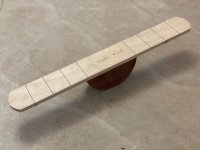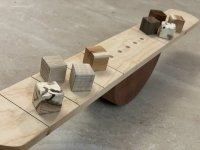
I set out to make this from some pictures on pinterest.
The concept is simply a semi-circular piece of wood with an attached blank above... onto this two players then place counter / cubes / marbles etc. with the aim of keeping it in balance and not letting it tip over... If using marbles then it would seem that a series of grooves of dimples are used to locate the marbles.
I started with a piece of steamed pear on the lathe and brought it up into a cylinder to then remove as a thick disk. I checked with a straight edge that I had consistent sides, but forgot to check whether those sides were at 90deg to the front face - so there is a very slight taper to the disk (which I don't think will matter).
This was then sliced in half on the mitre saw and sanded to give two d-shaped pieces as the rocking base...
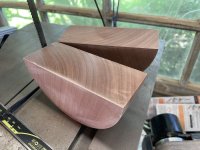
I checked a number of times and they are perfect semi-circles (the lathe would ensure that), but one seems to sit level and the other doesn't - though they appear identical... the only thing I can think of is that there is variable density to the wood across the piece so that it is slightly heavier on one side than on the other...
I wanted a piece of wood for the top plank which had a slight overhang and was c. 3x the length of the base - cue a stack of maple conveniently already cut to the right length. - So pieces were sanded down, a quick semi circle drawn at each end (around a pot of wood filler!) and the ends sanded back to those lines...
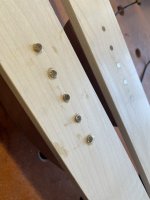
The next step (making two simultaneously as the disk was cut into two equal halves!) was to attach plank to base - the simple answer is just glue, but to make it a bit more fun I marked out 5 holes at 20mm apart along the centre line and then drilled them at 5.2mm - the planks were easy to drill, the bases a little harder as they needed to be wedged to present parallel to the pillar drill. Accuracy on this was okay but not perfect, but a few small adjustments and we had holes that lined up on the two pieces. The base holes were 10mm deep and the top plank was also 10mm, so pieces of 5mm brass rod were cut c. 25mm long and then it was all glued together - 2-part epoxy in the holes / for the brass and wood glue for the top to base. A little hammer persuasion meant all pieces of brass went in just fine and it was all clamped together to glue over night...
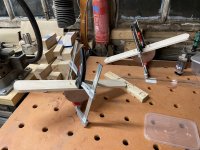
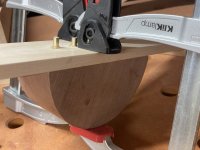
next morning and all had set well - bandsaw was used to trim back the brass excess - then up against the 60g disk sander to bring it down to almost the wood level, and then all of it on the 240g belt sander to finally remove glue / sand down wood / sand down the brass - you can see the finished sanding in the one sitting behind...
more to come as it carries on being made.
The concept is simply a semi-circular piece of wood with an attached blank above... onto this two players then place counter / cubes / marbles etc. with the aim of keeping it in balance and not letting it tip over... If using marbles then it would seem that a series of grooves of dimples are used to locate the marbles.
I started with a piece of steamed pear on the lathe and brought it up into a cylinder to then remove as a thick disk. I checked with a straight edge that I had consistent sides, but forgot to check whether those sides were at 90deg to the front face - so there is a very slight taper to the disk (which I don't think will matter).
This was then sliced in half on the mitre saw and sanded to give two d-shaped pieces as the rocking base...
I checked a number of times and they are perfect semi-circles (the lathe would ensure that), but one seems to sit level and the other doesn't - though they appear identical... the only thing I can think of is that there is variable density to the wood across the piece so that it is slightly heavier on one side than on the other...
I wanted a piece of wood for the top plank which had a slight overhang and was c. 3x the length of the base - cue a stack of maple conveniently already cut to the right length. - So pieces were sanded down, a quick semi circle drawn at each end (around a pot of wood filler!) and the ends sanded back to those lines...
The next step (making two simultaneously as the disk was cut into two equal halves!) was to attach plank to base - the simple answer is just glue, but to make it a bit more fun I marked out 5 holes at 20mm apart along the centre line and then drilled them at 5.2mm - the planks were easy to drill, the bases a little harder as they needed to be wedged to present parallel to the pillar drill. Accuracy on this was okay but not perfect, but a few small adjustments and we had holes that lined up on the two pieces. The base holes were 10mm deep and the top plank was also 10mm, so pieces of 5mm brass rod were cut c. 25mm long and then it was all glued together - 2-part epoxy in the holes / for the brass and wood glue for the top to base. A little hammer persuasion meant all pieces of brass went in just fine and it was all clamped together to glue over night...
next morning and all had set well - bandsaw was used to trim back the brass excess - then up against the 60g disk sander to bring it down to almost the wood level, and then all of it on the 240g belt sander to finally remove glue / sand down wood / sand down the brass - you can see the finished sanding in the one sitting behind...
more to come as it carries on being made.